
Stackable Guides for Full-Arch: How the Stack Indexes, and What It Needs From You

Updated: Sep 24
Clinically reviewed by Jacob Shrayman, DDS, a general dentist who places implants using TrueGuide surgical guides in his own practice.
A stackable guide is not a different kind of support. It is a way of keeping one reference alive through a surgery that destroys the surface every other guide depends on.
That is the whole idea, and it is worth stating plainly because most of what is written about stackable systems is written by the people selling them. This article covers what a stack is, what each component does, what we need from you to build one, and — the part almost nobody publishes — what the evidence actually shows about how accurate these things are. The short version of that last part: the published data is thin, it disagrees with itself, and the 2 mm safety margin still applies.
What a Stackable Guide Actually Is
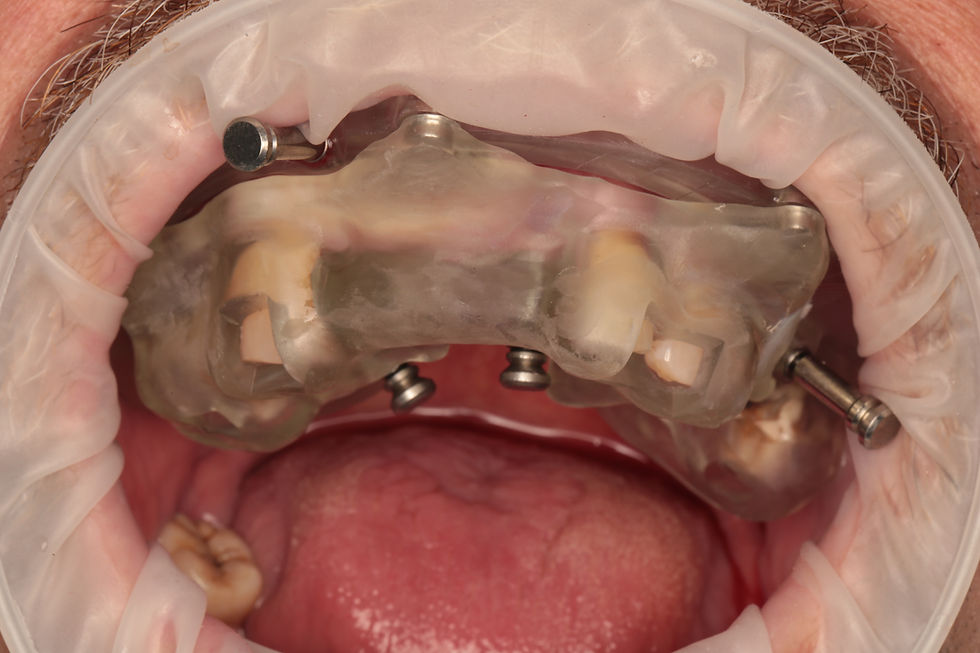
A stackable system is a set of guides that all lock onto one pinned base.
The base goes in first and is fixed to bone with pins. Then the bone reduction guide drops onto it, then the osteotomy guide, then the carrier that holds the provisional. Every component after the base indexes back to that same base, either by mechanical keying or, in some systems, by magnets.
The reason it exists is reference. Under a conventional full-arch guide, the moment you reduce bone the surface the guide was seated on no longer exists. So does the reference. On a stack, the pinned base survives the reduction, so the osteotomy guide and the carrier are still indexed to the position the case was planned in.
A stackable base can itself be tooth-supported, tissue-supported or bone-supported, depending on what is in the arch when you start. The support type is a separate question from whether the system stacks. The four supports and what each one needs is covered in its own article.
The Foundation Base
Everything in the case is only as good as this one component, because every later error is measured from it.
The base carries the pin sleeves and the indexing features, and nothing else. It is deliberately simple: no osteotomy sleeves, no reduction surface, nothing that would make it thicker or harder to seat than it has to be. The one published design specification we can point to used a minimum cross-section of about 3 mm and an average vertical height of about 5 mm, with a 200 micron spacer built into the indexing interface.
What we need from you to place it well is a clear decision on where the base seats. If you are extracting at the same visit, the base cannot take its support from a tooth that is coming out, and the sequence — extract first, then seat, or seat first, then extract through it — has to be settled at the plan review, not in the chair.
The Pins
Published full-arch protocols use three or four fixation pins, most commonly 1.3 mm in diameter, with the same count in the maxilla and the mandible. Pins go palatal in the upper arch and between the foramina on the buccal in the lower, placed where there is bone to take them and where they are clear of every planned osteotomy. Pin positions come to you on the plan before anything prints.
Two honest points about pins, because they are oversold.
First, pins reduce micro-movement; they do not remove it. In a partial-arch in vitro model, bilateral pins improved angular deviation from 3.65 degrees to 1.88 degrees and apex deviation from 2.18 mm to 1.53 mm, which is a real effect. But in a complete-arch edentulous comparison, a pinned two-guide system came out significantly less accurate than a plain flapless mucosa-supported guide — 2.84 degrees against 2.03, and 1.22 mm at the apex against 0.97. Pin fixation is not automatically more accurate in a full arch.
Second, there is no published evidence on how pin count relates to deviation in the full arch, and none comparing maxillary and mandibular pin protocols. Anyone who gives you a number for that is giving you an opinion.
If a pin does not seat — it spins, it engages nothing, the bone under it is softer than the CBCT suggested — the base is not fixed and the stack above it is not indexed. Stop there. A base you are holding down is the same problem as a guide you are holding down, one layer earlier and with more riding on it.
The Bone Reduction Component
The reduction guide drops onto the pinned base and gives you a flat reference surface at the planned level.
How much bone comes off is decided by the space the restoration needs, and that space is measured from the implant platform to the opposing occlusal plane, not from the ridge crest. The published minima are about 15 mm for a screw-retained acrylic-titanium hybrid, about 11 mm for a splinted bar overdenture, and about 7 mm for an unsplinted Locator-style overdenture.
We plan the reduction to the restoration and show it to you on the plan. How much comes off a particular patient is your call at the plan review.
Here is what is not known, and we would rather say so. There is no published study measuring planned against achieved alveoloplasty in millimeters. The literature reports implant accuracy after reduction; it does not report reduction accuracy itself. Nor is the loss of the seating reference after reduction quantified anywhere — it is a mechanism everyone agrees exists and nobody has measured. The claim that a pinned foundation eliminates it is a marketing claim, not a finding.
The Osteotomy Component
The osteotomy guide indexes onto the same base and carries the sleeves.
Sleeves are kit-specific, which matters more on a stack than anywhere else, because the stack is already consuming vertical room. Tell us the implant system, the platform and the guided kit by name on the Rx. Tilted implants are routine on a stack; the limits are pin and sleeve access at a steep angle and whether your kit's drills physically reach.
On vertical clearance, we will say what is known and what is not. The total stack height eats interocclusal space, and there is no published guidance on how much, or on a minimum mouth opening for a stacked assembly. Any number you have seen for that is unsourced. What we can do is measure it against your kit before it prints, which is why we ask for the patient's maximum opening and the site with the case.
The Carrier and the Provisional
The last component on the stack holds the provisional in the planned position so it can be picked up.
If you order the temporary with the case, we design it off the approved plan and it ships with the guide, ready to seat the same day. Single crown or a full-arch shell, either one. We also offer chairside assistance: a technician from the laboratory comes to your office for the surgery and does the conversion with you. If you would rather do the pickup yourself, we send everything ready.
The evidence here is thinner than the marketing. One series reports every prefabricated interim prosthesis picking up intraoperatively, with no misfit values published. Across the stackable literature as a whole, a provisional fracture rate of about 24% has been reported over 351 implants. Plan the visit as though the conversion will need chairside work, because sometimes it does.
What the Evidence Actually Shows
This is the section we would want to read, so it is the one we will write plainly.
Stackable-specific accuracy evidence amounts to three studies and roughly 150 implants, and they do not agree. A retrospective series of 60 implants in 15 edentulous arches using bone-supported stackable guides reported 1.25 degrees of angular deviation, 0.96 mm at the neck and 1.07 mm at the apex. A larger retrospective dataset of 73 implants across 17 arches on a commercial stackable workflow reported 4.23 degrees, 1.40 mm at the base and 1.60 mm at the tip — and an inter-guide agreement of only about 0.5. An in vivo comparison of four guide types found the bone-supported stackable performed worse than tooth-supported on every axis, at 5.42 degrees, and carried the largest vertical error of the four.
That is a 3.4-fold spread in reported angular deviation across the whole published record. The sub-1 mm, sub-3-degree figures that circulate in stackable marketing come from the smallest of those cohorts.
The right benchmark to plan against is still the pooled clinical data for static guided surgery: about 1.2 mm at the entry, 1.4 mm at the apex and 3.5 degrees overall, and for the fully edentulous subgroup specifically about 1.3 mm, 1.5 mm and 3.3 degrees, across 2,238 implants in 471 patients. Those are means. The same body of work recommends a 2 mm safety margin, and stacking does not retire it.
Four things a stack is most often said to solve have no supporting measurement in the literature at all: the accuracy of the planned bone reduction, the loss of reference after reduction, the fit of the carrier-delivered provisional, and the failure rates of the components themselves — pin loosening, base movement, mis-seating. Small case series reporting no complications are not evidence that those rates are low. They are evidence that nobody has counted.
Where the Stack Loses Accuracy
The error sources on a conventional guide all still apply: registration of the CBCT to the scan, the seat and any rocking, the play between drill, key and sleeve, and the free distance below the sleeve. A stack adds its own.
Every indexing interface is a tolerance. A four-component stack has three of them between the base and the carrier, and they do not cancel out. The published inter-guide agreement figure above — around 0.5 — is a measurement of exactly this: the components of one stack do not all land in the same place.
The base is the multiplier. A base seated 0.5 mm off does not put one implant 0.5 mm off; it moves the whole arch, and every component above inherits it. This is the argument for spending the time on the base and for stopping if a pin does not hold.
Verifying Seating at Every Stage
Check the base the way you would check any guide, and then check it again at every stage after.
A positive stop when it is seated dry. No rock under finger pressure at either end. Contact visible through the seating verification windows on both sides. On an edentulous case, confirm against the bite index. Then confirm every pin is engaged and the base does not move when you push on it.
After the reduction, before the osteotomy guide goes on, confirm the base has not moved. That is the check specific to a stack and the one most easily skipped, because by then the case feels like it is going well.
Surfaces that carry the seat and the sleeve housing are never adjusted chairside, on any component. Once the seating surface is relieved, the plan it was built from no longer applies.
When a Stackable Is the Wrong Answer
A stack is the right tool for a full-arch immediate case with alveoloplasty and a provisional to deliver. It earns its complexity when bone is coming off and a prosthesis is going on the same day.
It is the wrong tool when no bone is being reduced. If the arch needs no alveoloplasty, the reference never disappears, and a single pinned guide does the same job with fewer interfaces and less vertical room. It is also the wrong tool where access will not take the stack height, and on any case where the restorative plan is not settled — a stack built to an undecided prosthesis is an expensive way to find out you needed a different reduction.
If you are opening a flap anyway, a bone-supported design is worth discussing at the plan review. If you are not opening, a pinned tissue-supported guide is usually the better trade.
What We Need From You to Build One
Everything a full-arch case needs, plus what the stack adds. The full record specification is in its own article; this is the stack-specific list.
A CBCT in DICOM covering the whole arch, and on the mandible the canal where it enters and where it exits. An intraoral scan of both arches and the bite, or a dual scan with a well-fitting metal-free denture and six to eight radiopaque markers if the arch is edentulous. Retracted photographs and a natural smile. The opposing arch, every time.
On the Rx: the implant system, the platform and the guided kit by name. Which teeth are being extracted and in what order relative to seating the base. What is going on top — the actual prosthesis, not a placeholder — because the reduction is planned from it. The patient's maximum opening and the sites you are worried about. Whether you want the provisional made with the case. Whether you want chairside assistance, so we hold the day. And the surgery date, at the time you send the case.
If there are implants already in the arch that the plan has to reference, seat a scan body on each one and write the system and platform. If you work with photogrammetry, send the file with the scan and we build off it.
What We Do Not Decide
Our technicians plan from the CBCT and flag anatomy near the surgical site. The full radiographic interpretation stays with you. Whether this patient is a candidate, how much bone comes off, whether to tilt, whether to load, and where an implant finally goes are clinical decisions, and the plan comes back to you for exactly that reason. Revisions are unlimited and cost nothing until the guide prints, and nothing prints without your approval.
Stackable and other multi-layer guides depend on the guide design and the material, and the schedule is set with you at the plan review.
Common Questions
What is a stackable surgical guide?
A set of guides that all lock onto one pinned base. The base is seated and pinned first, and the bone reduction guide, the osteotomy guide and the carrier that holds the provisional each index back to it.
Why not just use one full-arch guide?
Because the moment you reduce bone, the surface a conventional guide was seated on is gone, and the reference with it. The pinned base survives the reduction.
Do I need a stackable guide if I am not reducing bone?
No. If nothing is coming off, the reference never disappears and a single pinned guide does the same job with fewer interfaces and less vertical room.
Can a stackable base be tooth-, tissue- or bone-supported?
Yes. The base takes whatever support the arch offers at the start, and the stack above it indexes to the base either way.
How accurate are stackable guides?
The published record is three studies and about 150 implants, reporting angular deviation anywhere from 1.25 to 5.42 degrees. Plan against the pooled static-guided figures — about 1.3 mm at the entry, 1.5 mm at the apex and 3.3 degrees in the fully edentulous — and keep the 2 mm margin.
Are stackable guides more accurate than a single-piece full-arch guide?
Not demonstrably. One in vivo comparison found a bone-supported stackable less accurate than tooth-supported on every axis, and a complete-arch study found a pinned two-guide system less accurate than a plain mucosa-supported guide. The case for stacking is reference through a bone reduction, not accuracy.
How many fixation pins does a stack need?
Published protocols use three or four, most commonly 1.3 mm, the same count in either arch. There is no published data relating pin count to deviation in the full arch.
Where do the pins go?
Palatal in the upper arch, between the foramina on the buccal in the lower, in bone that will take them and clear of every planned osteotomy. Positions are on the plan before anything prints.
Do pins make a guide more accurate?
In a partial-arch model, measurably yes — angular deviation dropped from 3.65 to 1.88 degrees with bilateral pins. In the complete arch the evidence goes the other way. Pins reduce micro-movement; they do not remove it.
What if a pin does not seat?
Stop. An unfixed base is not indexed, and everything above it inherits that. Holding a base down is worse than holding a guide down, because it is one layer earlier.
Do I need a bone reduction guide?
If you are going to a fixed hybrid and need restorative space, yes. Without one the reduction is estimated, and where that shows up is conversion, with the space short.
How much restorative space does a full-arch case need?
Measured from the implant platform to the opposing occlusal plane: about 15 mm for a screw-retained acrylic-titanium hybrid, about 11 mm for a splinted bar overdenture, about 7 mm for an unsplinted Locator-style overdenture.
How accurate is the bone reduction itself?
Unknown. No published study measures planned against achieved alveoloplasty in millimeters. We plan the reduction to the restoration and show it to you; we do not claim a tolerance nobody has measured.
Can you guide tilted implants on a stack?
Yes, routinely. The limits are pin and sleeve access at a steep angle and whether your kit's drills reach.
Will the stack fit in the patient's mouth?
That is the question to ask before it prints. There is no published minimum opening for a stacked assembly, so we measure the stack against your kit and the opening you send us. Measure at the site you are most worried about.
Can you make the provisional before surgery?
Yes, if you order it with the case. We design it off the approved plan and it ships with the guide, ready to seat the same day. Single crown or a full-arch shell.
Who converts the denture on surgery day?
We offer chairside assistance — a technician from the laboratory comes to your office and does the conversion with you. Book it with the case so we hold the day. If you would rather do the pickup yourself, we send everything ready.
How often does the provisional break during conversion?
A fracture rate of about 24% has been reported across the stackable literature, over 351 implants. Plan the visit as though it may need chairside work.
What is the most common failure point on a stack?
Nobody has counted, and we are not going to pretend otherwise — there is no published frequency data on pin loosening, base movement or component mis-seating. Mechanically, the base is the one that costs the most when it is wrong, because it moves the whole arch.
Do the stacking interfaces add error?
Yes. Each index is a tolerance, and a four-component stack has three of them. Reported inter-guide agreement in one dataset was only about 0.5, meaning the components of a single stack did not all land in the same place.
How do I check the base is seated?
A positive stop when seated dry, no rock under finger pressure at either end, contact through the seating verification windows on both sides, and on an edentulous case a check against the bite index. Then confirm every pin is engaged.
What do I check after the bone reduction?
That the base has not moved, before the osteotomy guide goes on. It is the check specific to a stack and the easiest one to skip.
Can I adjust a stack component chairside?
Never the seating surfaces and never the sleeve housing, on any component. A tissue undercut on a surface that does not carry the seat, lightly, yes.
Do I still need a backup plan?
Always. The plan and the drill report give you positions and depths whether or not the guide is in the mouth, and your regular drills should be open on the tray.
Do I need photogrammetry if I have a stack?
They do different jobs. The guide puts the implants in; photogrammetry or a jig records where they actually ended up, for the final. We work with photogrammetry — send the file with the scan.
How long does a stackable case take to make?
Stackable and other multi-layer guides depend on the design and the material, and the date is set with you at the plan review.
Which stackable system do you build?
We build to the system and guided kit you own, and we design the stack around your case rather than around one product. Tell us what you have on the Rx.
Send a Case
Upload your CBCT, scans, bite, photographs and Rx on the Submit a Case page, or call (201) 255-4233 and we will tell you whether the case needs a stack before you take another record.
References
Tahmaseb A, Wu V, Wismeijer D, Coucke W, Evans C. The accuracy of static computer-aided implant surgery: a systematic review and meta-analysis. Clin Oral Implants Res. 2018;29(Suppl 16):416-435.
Bjelica R, Smojver I, Stojic L, Vuletic M, Katanec T, Gabric D. Accuracy of fully guided implant placement using bone-supported stackable surgical guides in completely edentulous patients: a retrospective study. J Clin Med. 2026;15(2):652.
Eldabe AK, Adel-Khattab D, Beshay GNF, Botros KH. Analysis of accuracy of four types of fully guided dental implant surgical guides: an in vivo study. BMC Oral Health. 2026;26:1120.
Chen X, Yang Z, Wang Y, Fu G. Fixation pins increase the accuracy of implant surgery in free-end models: an in vitro study. J Oral Maxillofac Surg. 2023;81(5):593-601.
Chen YJ, Lu Y, Liu F, Saglik B, Stuhr SH, Li J. Accuracy of pin-supported surgical guides for complete arch implant placement: a comparison with conventional mucosa-supported guides. J Prosthet Dent. 2026;135(4):808.e1-808.e7.
Mijiritsky E, Ben Zaken H, Shacham M, Cinar IC, Tore C, Nagy K, Ganz SD. Variety of surgical guides and protocols for bone reduction prior to implant placement: a narrative review. Int J Environ Res Public Health. 2021;18(5):2341.
Alruhailie L, Zaidan A, Alasmari A, Raffa O. A fully guided sequential template immediate loading protocol for dual-arch rehabilitation. Clin Cosmet Investig Dent. 2024;16:167-177.
Sirbu I, Nastasie V, Custura A, et al. Facially driven full-arch implant rehabilitation with stackable surgical guides and immediate loading. Dent J. 2025;13(11):516.
Carpentieri J, Greenstein G, Cavallaro J. Hierarchy of restorative space required for different types of dental implant prostheses. J Am Dent Assoc. 2019;150(8):695-706.


Comments